
Canadians remember 11 November 1918 as the day the armistice ended the fighting on the Western Front. For my family, the tragedy came one day earlier. At four o’clock on the afternoon of 10 November, my twenty-one-year-old great-grandmother, Lujza Daku, died on a Saskatchewan farm after nearly two weeks of illness.1
Daku Lujza — Hungarian names place the family name first — was born on Friday, August 13th, 1897, to Kaponyás Terézia and Daku András in the village of Bezdéd, near the Upper Tisza river in the Austro-Hungarian Empire. She was the family’s youngest child and only daughter, with four older brothers: Sándor (b. 1880), Elek (b. 1884), András (b. 1887), and Lajos (b. 1890). The Daku name had been present in Bezdéd for centuries — a 1704 conscription roll for the village already lists Daku householders — and she had countless cousins scattered through the small villages of the region. Her father registered the birth at Bezdéd seven days later. The civil entry described him as a smallholder and day labourer and recorded both parents as members of the Reformed faith.2, 3
As a baby, Lujza may have worn a little shirt sewn from her father’s or brothers’ worn underwear, decorated with a pink, hand-crocheted collar, and a crocheted bonnet trimmed with pink ribbon. For the first few weeks, according to Magyar custom — Magyar being what Hungarians call themselves in their own language — cousins and neighbours would have brought the family food while Terézia recovered from childbirth and nursed her newborn. But work never ceased, and after a few days, new mothers typically swaddled their babies tightly into a pillow — arms and legs straightened and restrained — so they could keep the infant safe and nearby throughout the day. As Lujza grew, she likely toddled freely around the house and yard while her mother cooked the meals, washed the clothes, tended the vegetable garden, and hand-churned milk into cream and butter.5, 6
Households were formal and puritan. If they followed local custom, András addressed Terézia as “Dakuné asszony,” and Terézia addressed her husband as “Daku úr” — essentially, “Mrs. Daku” and “Mr. Daku.” They would have said Grace at every meal, attended church on Sunday, observed the Sabbath, and read the Bible again and again. But there was more to their life than religion. Half the Magyars in the region were literate at the time, and in their few moments of leisure they composed poetry, played music, and danced.5
Sándor later described their home in Hungary:4
“Our father, while at home, was a member of the old guild of bootmakers and, because of this, until the time I was big enough to hold the handles of a plough, mother operated the small farm. In accordance with the prevailing practice of the time, father started work at six in the morning and continued until eleven or twelve at night. This he did also because of the tradition of the women of the community by which they would do their spinning in the long winter evenings in the bootmaker’s workshop.
Also, the farmers used to call in to discuss politics and other public affairs. It was there that I heard, for the first time, about the brilliance of Louis Kossuth, the rest of the heroes of the War of Independence, and its events. It was there that I was first told by the pious peasants that war was in the offing. In the first instance, because very many young men had been called up and secondly, because Louis Kossuth had returned from Italy in disguise, in order to visit every community and call upon the people to rise again and fight for freedom.”
On those long winter evenings — her mother spinning flax into linen, her father and brothers stitching leather into boots — Lujza may have played at their feet, listening to the news of the village. That talk of war certainly helped push the Daku family out of Hungary, but other pressures were building too: land prices rising with the population boom, and prices for goods and produce falling as industrialization accelerated. Whatever the mix of motives, the family began to consider leaving Hungary. They were far from alone.4
The Magyar Diaspora
Terézia had been born in Záhony, six kilometres north of Bezdéd. Though her parents had passed on, she still had family there, including an older sister, Kaponyás Rebeka, who had married Czeto István. In late April 1900, István and Rebeka left Hungary for Canada with their children and a grandchild.
In the early spring of 1901, three-year-old Lujza may have accompanied her family to the Royal Hungarian State Railway station to bid farewell to her 20-year-old brother, Sándor. He took the train south and west to Budapest, then north out of the Austro-Hungarian Empire to the German city of Bremen, where he boarded the steamer S.S. Karlsruhe. On March 4th, 1901, as the ship steamed through New York Harbour toward Ellis Island, Sándor may have stood on the tiny portion of deck permitted to steerage passengers to catch a glimpse of the Statue of Liberty. He was examined, cleared, and entered the United States of America.
Once Sándor was settled, he wrote home encouragingly, and Lujza soon said goodbye to another brother. Seventeen-year-old Elek departed Europe from Hamburg aboard the steamer Fürst Bismarck and arrived in New York on September 20th, 1901. At home, 14-year-old András and 11-year-old Lajos had to pick up the slack for their missing brothers.
Sándor and Elek found work at the Carnegie steel mill in Duquesne, Pennsylvania, and wrote home that they were well paid — in gold — which enticed other young men in Bezdéd to leave for America. The two may have expected their parents to be excited by the news and join them there, but Terézia and András wanted to be farmers, not factory workers. They wrote back instead about a small farm for sale near Bezdéd. Then a new opportunity arose.
Austria-Hungary had banned pamphlets and advertisements promoting emigration to Canada; the Empire was simply losing too many workers. But nothing prevented people from receiving letters from family abroad. Rebeka and István Czeto had settled near Whitewood, in the Saskatchewan District of the Canadian North-West Territories, alongside families from Bótrágy, a village 25 kilometres west of Bezdéd. One of those settlers, János Szabó, had established a Protestant Hungarian colony south of Whitewood named Bekevar — “fortress of peace” in Hungarian — intended for about 200 settlers. He and his compatriots wrote letters home to attract fellow Bótrágians but could not draw enough families. Rebeka may well have heard about the nearby colony and written to her sister.
However they learned of Canada and Bekevar, András and Terézia discovered that Canada offered a quarter section of land — 160 acres — for only $10, with the option to buy a neighbouring quarter once they had sufficiently improved their own. They already had family in the region, and more families from Bezdéd intended to join the colony. The deal was too attractive to resist. They sold their property and tools and prepared to leave their home forever.
Canada paid $5 for every immigrant delivered to the Canadian West, so German steamship-line agents skulked across the Hungarian countryside spreading word of Canada and offering to arrange transportation. András and Terézia may have contacted one of these agents, who organized passage by train to Hamburg, where another agent would help them board their steamship.
A Journey of 11,000 Kilometres
In late May 1902, András, Terézia, András Jr., Lajos, and Lujza made their way to the train station one last time. Following the standard advice from friends and family, they may have sold off most of their personal property, intending to buy what they needed in Canada. Even so, their backs surely bent under trunks filled with clothing, feather-beds, and household utensils. They did not travel alone; several families followed the same route from Záhony, though most were bound for Winnipeg rather than Saskatchewan.
The family probably began with a local train from the Bezdéd area, connecting to the main railway lines converging on Budapest. From the Hungarian capital, the natural route to Hamburg continued through Vienna and across Germany. The railway network leaves little doubt about the broad course of the journey.
The Royal Hungarian State Railway carried the family south from their village of a few hundred people, past the neighbouring villages of Tüzér and Komoró, around the larger towns of Kisvárda and Nyíregyháza, and out of Szabolcs province, probably farther than any of them had ever ventured. After a few hours of bumping, lurching travel, the train turned west through Debrecen and Karcag, the home of Lujza’s future husband, and across the Carpathian Basin toward Budapest, rumbling along at 50 kilometres per hour and stopping at small stations across the Hungarian kingdom. With all the stops, the journey likely stretched through the day, the night, and into the next day before finally delivering them to Nyugati Pályaudvar, one of the city’s main railway stations.
The station stood at the centre of a city of almost 800,000 people, near the Danube River, by far the grandest sight of human civilization that Lujza and her family had ever beheld. From there they boarded another train for Hamburg, a journey of a few days that took them through Vienna, capital of the Habsburg Empire, a magnificent imperial city of 1.7 million and the sixth-largest city in the world.
The family was booked to leave Hamburg aboard the S.S. Armenia, a 399-foot steamship built in 1896 and operated by the Hamburg-America Line. To manage the growing flow of emigrants from eastern Europe, the company had opened a purpose-built complex on Hamburg’s Veddel in 1901. The fifteen-building site could accommodate about 1,200 people and included sleeping quarters, a dining hall, washing facilities, a hospital, a synagogue and a church. Now remembered as BallinStadt, the emigrant halls housed and processed passengers while they waited to board their ships. As steerage passengers travelling with the Hamburg-America Line, the Daku family likely passed through the company’s organized emigrant system before boarding the Armenia.
No account survives of the Daku family’s own days in Hamburg or of their crossing aboard the Armenia. Contemporary descriptions of the emigrant facilities and steerage travel on comparable ships, however, give a close sense of the system through which they passed.
The shipping line organized the movement of Eastern European passengers from the railway into its emigrant halls on the Veddel. There, their papers and health were examined, and bathing and disinfection formed part of the complex’s rigorous hygiene system. Sleeping quarters were organized by nationality, religion and gender, with instructions posted in Hungarian and several other eastern European languages. Lujza and her family would have waited among a much larger and more varied migrant population than they had known in Bezdéd. Food at the halls was reportedly plentiful, and music and dancing sometimes continued until the morning of departure. One contemporary observer remembered that emigrants emerged from the bathing and disinfection process carrying the unmistakable smell of hot steam and carbolic acid.
On 31 May 1902, Lujza and her family boarded the S.S. Armenia among nearly 1,000 passengers, including 254 children under 14 and 82 infants. Their steerage passage placed them in shared sleeping compartments fitted with tiers of bunks below the upper decks. Privacy was slight, ventilation was poor, and access to the open deck became difficult when hundreds of passengers competed for space.7
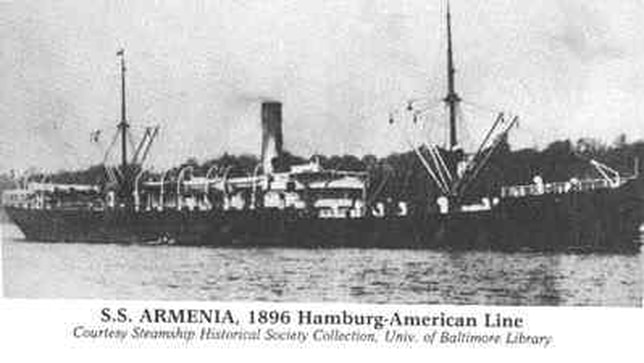
Contemporary accounts of comparable German steamships describe seasickness, oppressive air when bad weather forced the hatches closed, and meals ladled from large kettles into passengers’ pails amid pushing and confusion. The food varied in quality, and passengers on at least one other Hamburg-America voyage found the bread so poor that they threw it overboard. Thirteen days in crowded steerage would almost certainly have been noisy, uncomfortable and exhausting.
Though Lujza could see little of it from the steerage deck, the S.S. Armenia steamed up the Elbe and out into the North Sea, then down the English Channel to Boulogne-sur-Mer, France, where still more passengers came aboard: over 140 Syrian men, women, and children bound for Montreal.
At last the ship steamed out into the Atlantic. Lujza and her family would spend almost two weeks aboard. They were fortunate to meet no major storms, though rough weather surely found them from time to time — a wave that rocked the ship could easily send people tumbling from their cots and scatter belongings across the deck. During the passage, Lujza would have heard the chatter of a dozen languages and listened to songs and music from several cultures. Some passengers dressed in modern 20th-century clothes; others wore peasant attire and sheepskins, the men with long hair greased with lard, the women bundled in patterned shawls.
The S.S. Armenia arrived at Halifax on June 13th. The steerage passengers, clean and well-scrubbed at the start of their voyage, stumbled off the ship in a bedraggled state. After a cursory medical examination, immigration and Canadian Pacific Railway agents directed them onto waiting colonist cars headed west.8
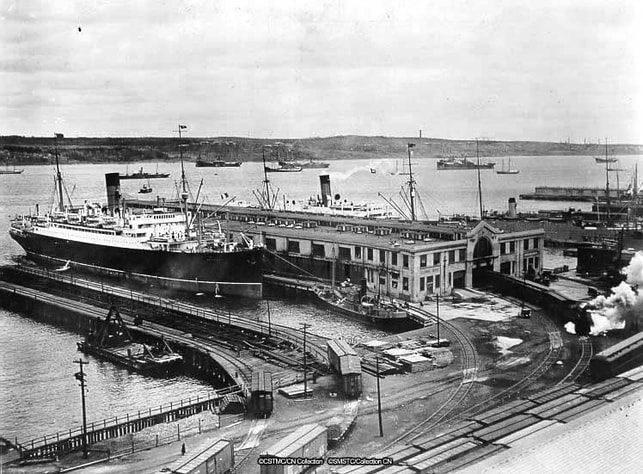
Before departure, András and Terézia likely had to buy enough food to last the several-day trip to Saskatchewan. On the colonist car they sat on hard bench seats — perhaps padded with the blankets and pillows they had brought — and took turns with other families sleeping on the fold-out bunks at the back. They shared a single cooking stove and two toilets with the rest of the car.
Accustomed to the well-cultivated, well-populated landscape of Europe, András and Terézia may have been dismayed by the raw, rugged wilderness rolling past. Even the cities and towns looked rough and small compared to the stately capitals they had passed through on their way across Europe. When the family finally passed from the vast forests of northern Ontario onto the enormous, seemingly endless grasslands, they may have felt terribly isolated and, for the first time, understood the conditions in which they would live.
Most of the Hungarians and Galicians left the train at Winnipeg, a respectably large town of over 40,000. But the Daku family rode one more day and stepped off at Whitewood, where the Hudson’s Bay Company had established a trading post in 1891. By 1902, the town’s population had climbed to 400.
Bekevar
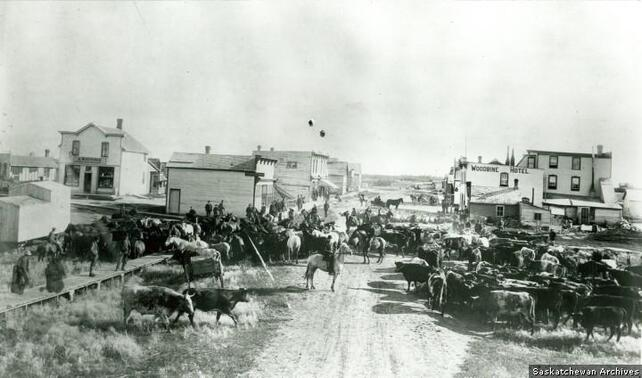
András and Terézia were fortunate compared to many settlers. With family and fellow Hungarian colonists already in the area, they likely knew of a good claim in advance, and a friend or relative may even have met them to guide them to their new home. András probably rented or purchased a team and wagon, bought the supplies they would need on an isolated homestead, and headed south down whatever rudimentary track earlier settlers had managed to carve out.
After selecting their land and travelling to Regina to stake their claim, the family wrote to Sándor and Elek, inviting them to join the family in the colony. Since every man over 18 could stake his own claim, the two sons quickly rejoined the family. With their arrival in Canada, the family’s names changed too: Lujza became Louise, András became Andrew, Terézia became Teresa, Sándor became Alexander, András Jr. became Andrew Jr., and Lajos became Louis, but Elek remained Elek.
Canadian censuses soon place the family in this prairie world. In 1906, eight-year-old Louisa lived with her parents and older brothers Alex, Andrew, and Louis in Assiniboia East; all were recorded as Hungarian-born immigrants of 1902.9 The 1911 census found her again with her parents and a large extended Daku household in Township 12, Range 5, west of the Second Meridian. She was thirteen, unmarried, Hungarian-born, Presbyterian, and able to read and write.10
For the first several months, five-year-old Louise and her family likely lived with several other families in a makeshift log building. With help from fellow colonists, her parents soon built a log house of their own. Louise still shared a single sleeping room with her parents and brothers, though the house had a separate kitchen, and shortly afterward the family likely added a small upper floor. By 1903, Bekevar consisted of 45 homesteads.
To claim their land, Andrew and Teresa had to meet several milestones set out in the Dominion Lands Act. A settler had to begin cultivating the homestead within six months of entry; break and prepare at least five acres in the first year; crop those five acres and break ten more in the second; build a habitable house by the end of the second year and take up residence at the start of the third; and finally give six months’ written notice of intent to apply for the patent.
Louise’s first chores were to round up strayed livestock, but she was soon feeding and milking the cows and taking them to pasture before leaving for school. Men and women kept a clear division of labour, but with so much to do and so much land, Louise likely helped her brothers pick stones from the fields while her mother joined her father behind the plow, breaking the tough prairie sod.
On August 25th, 1904, Andrew filed for a homestead in Township 12, Range 6, Section 36, which he successfully patented. Since every second quarter was CPR land, available for purchase once a settler patented his first homestead, he bought an adjoining 160 acres. By 1920, his sons Alex, Andrew Jr., Elek, and Louis had claimed homesteads of their own and purchased additional quarters. Surrounding the Daku homestead were several families whose children would intermarry with theirs: the Debrecenis, the Kimeris, the Fonagys, and the other Daku family, headed by Károly Daku, who had also emigrated from Bezdéd in 1902. Daku households appear in Bezdéd’s records as far back as 1704, so the two families were likely distant cousins, though no close relation.
In 1907, the Canadian Northern Railway built a rail line close to Bekevar, and in 1908 it constructed Kipling Station — named after Rudyard Kipling, who had visited Regina in 1907. The station made it much easier for local farmers to get their crops to market; some even drove their harvest in on wagons. A town of the same name quickly grew around the station, and Kipling became the commercial hub of the region. As elderly Hungarians retired into town, more of the community’s social and religious life moved there with them.
The community petitioned for a school in 1905, and in 1906 the government built the Magyar School for the district’s 20 school-aged children. Louise was about nine when she first attended school in Canada, and since her teachers spoke English, they gave her her first formal English education. The school also served as a prayer-house, and the family travelled there every Sunday until the Bekevar Church was completed in 1912, when Louise was 14. With no Hungarian Reformed Church in Canada, most of the Hungarians joined the Presbyterian congregation, though many would later become Baptists.
At services in the Bekevar Church, everyone had their place: single men sat in the choir, single women downstairs on the left, married women on the far left, and married men on the right. Louise may have been among the first confirmed in the Presbyterian faith at the Bekevar Church, after which she would have taken her seat in the back with the single women.
Courtship and Marriage
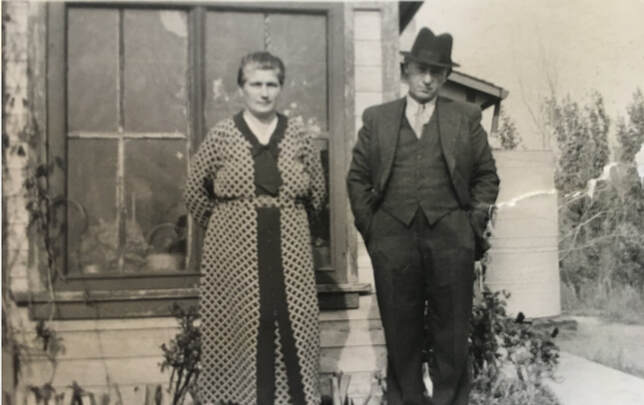
After services, the young people played games and walked home together in groups. It may have been then that Louise first took an interest in Lawrence Debreceni, the son of József Debreczeni and Juliánna Jonás. In 1912, Lawrence was 19 — almost six years older than 14-year-old Louise. His family came from Karcag, a much larger and more cosmopolitan town than tiny Bezdéd. The Debrecenis were the wealthiest family in Bekevar. They had migrated to Canada through New York in a second-class cabin, avoiding the purgatory of steerage, and had arrived with $4,000 in cash. Instead of building a rough log house, they hired craftsmen to build a proper framed home. Yet like the Dakus, they were bootmakers who had worked their way up from peasantry.
Groups of young men commonly called on families with daughters, letting the young people mix under the parents’ supervision. At the same time, Louise’s oldest brother, 32-year-old Alex, was courting Lawrence’s sister, 28-year-old Maria Debreceni, so the families may already have been mingling socially. However their courtship began, Lawrence would eventually have started visiting alone — the signal of his intention to court Louise.
Louise likely also attended the community’s many dances, which usually followed weddings or were organized by word of mouth after church. And there was a whirlwind of weddings in those years, as Louise’s brothers and cousins married, along with many other young people in the community. Her brothers Alex, Elek, and Louis played these events regularly as the Daku Band, earning $1.50 each plus three glasses of wine or brandy. Starting at eight in the evening in a log barn, they played the csárdás — the traditional Hungarian folk dance — and waltzes until morning. Louise would have worn her Sunday dress, and Lawrence would have invited her onto the floor with a bow and a formal “May I have the pleasure?”
No reviewed marriage record has yet established the exact date or ceremony, although the birth of their first child places Louise and Lawrence together by October 1913.11 If they followed the community’s traditions, Lawrence would first have asked Andrew for permission to marry Louise, and the minister would have announced the engagement in church on three consecutive Sundays. As the wedding day neared, the couple’s vőfély, the master of ceremonies, donned a bright ribboned hat and rode around Bekevar in a decorated buggy, inviting everyone to the ceremony. On the day itself, Andrew and Teresa hosted a dinner for family and friends, after which the bride and groom left separately for the Bekevar Church to be married. Afterward, everyone travelled to the groom’s house, where the women of the community laid out an elaborate dinner, followed by dancing, music, poetry, and other festivities.5
Around the same time, their older siblings Alex and Maria also wed. Not long after his own wedding, Alex quit the Daku Band at Maria’s urging. He had played the cimbalom, a Hungarian instrument popular among the Roma, but Maria complained that there was too much drinking at the dances and that staying up so late interfered with his farm work.
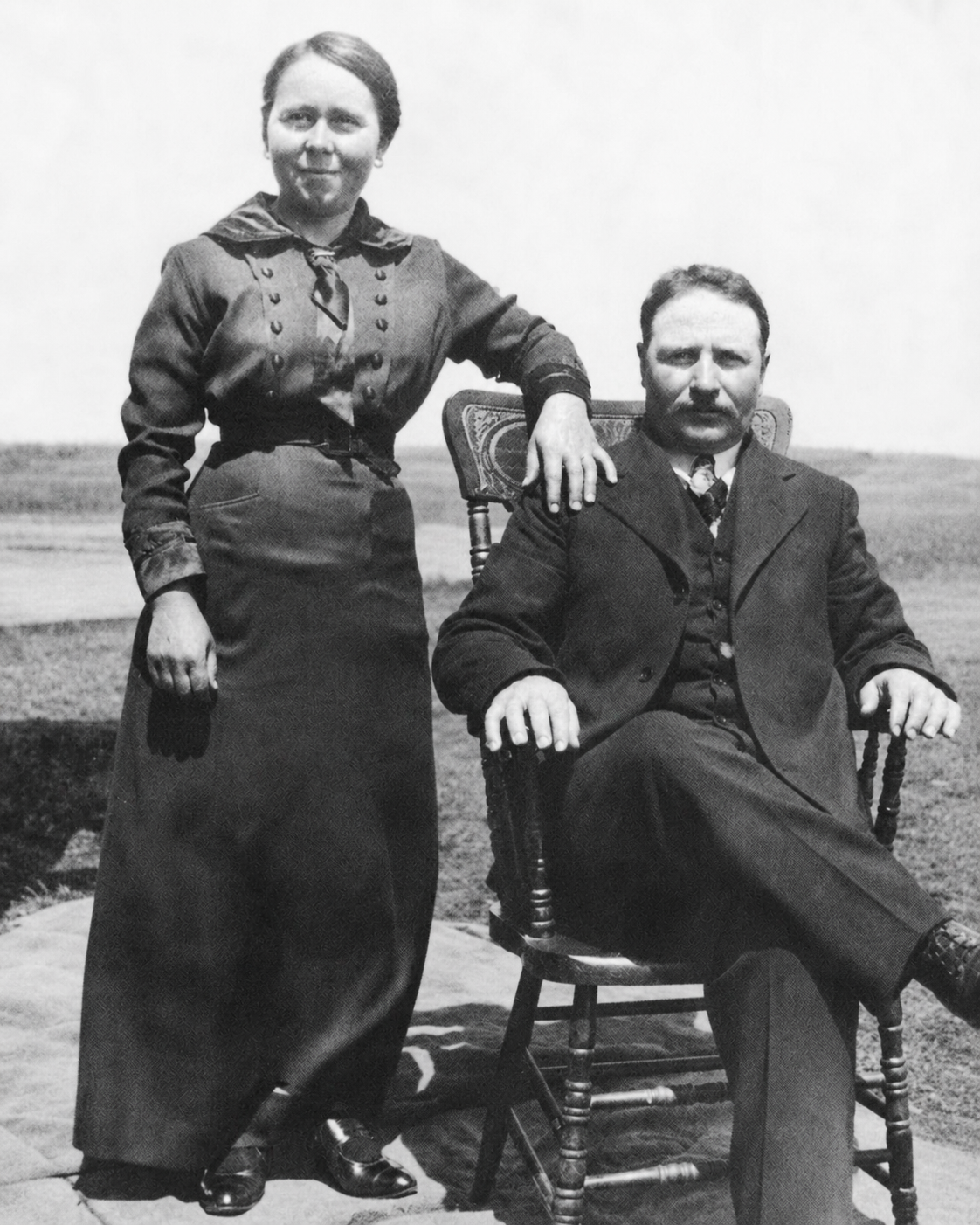
A New Family
Lawrence and Louise farmed a quarter-section that lay between their two families and began by building their new house together. Like her mother before her, Louise would have found there was too much work for any strict division of labour. Bekevar wives harnessed horses, helped in the fields, fed the animals, milked the cows, tended the garden, cooked meals, laundered clothes, and cleaned the house. Much of their time went to hand-churning milk into cream and butter; once a week they harnessed the horses to the buggy and drove into Kipling, where the sale of dairy goods covered the weekly grocery bill. The 1916 census places them in the Hazelwood district with Mary and Joseph, with Lawrence farming on his own account and Louisa recorded as speaking Hungarian and English and able to read and write.12
These responsibilities soon grew heavier for Louise. At 16, she became pregnant and delivered a baby girl, Mary, in late 1913. Two years later, a son, Joseph, joined the family on October 27th, 1915. As at her own birth, the women of the community typically brought meals and helped with chores while the new mother recovered. She had her children baptized at the Bekevar Church, and — religious observance being so important — continued to attend services, breast-feeding her infants under a cloth during the long sermons.11
The joy of her growing family was soon mingled with grief. Her aunt Rebeka died on December 19th, 1914, only days before Christmas, at the age of 61. Tragedy then struck closer still: Louise’s mother, Teresa, died less than a year later, on November 14th, 1915, at 58. Both were buried in the Bekevar Cemetery. Andrew Sr. would live with his youngest son, Louis, and his family until his death in 1933, at the age of 79.
In 1914, a world war had erupted. As a Dominion of the British Empire, Canada was automatically at war with Germany and the Austro-Hungarian Empire, and Louise’s many cousins back in Bezdéd would have been conscripted to fight against Russia, Britain’s ally. Her parents’ old fear of conscription had finally come true, though much later than they had expected.
The war nevertheless cast a shadow over immigrant communities. Canada imposed registration and other restrictions on some people born in countries now considered enemies, including Austria-Hungary. There is no evidence that the Hungarians at Bekevar were interned or directly persecuted, but their former nationality may have exposed them to suspicion or unease during the war years. For the Daku and Debreceni families, however, the surviving records show ordinary farm and community life continuing.
Life went on, of course, and Louise was soon pregnant again. Her daughter Julia was born on November 1st, 1917. At 20 years old, Louise had three children under four and a farm to run; life must have been a challenge, to say the least. But times were also good. Between 1915 and 1918, the price of wheat nearly doubled, and with butter and cream covering most household expenses, the growing family prospered. They must have been hopeful for the future.
The Spanish Flu
In 1918, influenza swept across Canada in a pandemic caused by an H1N1 virus. It could produce severe illness and pneumonia even in otherwise healthy people.13 In June, the Regina Leader-Post published only a few stories about the Spanish Influenza. The epidemic was happening far away, and the paper even framed it as good news, a flu doing its part to help the Allies win the war.
On July 6th, the paper reported the Spanish Influenza spreading through the German civilian population. On July 9th, the flu was hampering the German army across the whole front. On July 11th, even the Emperor of Germany and his staff were reported down with the disease. By late July, the paper described the flu sweeping through the German army so rapidly that it had forced the postponement of an offensive.
By August, the Spanish Flu had crept closer to the Canadian prairie, but the newspapers still treated it lightly, perhaps to avoid distracting from the war effort. One story announced new health measures in New York City, including a caution against kissing, under the playful byline “Someone’s always taking the joy out of life.”
In September, the stories turned serious. The Prime Minister of Great Britain and his staff were gravely ill. Seventy people died in twenty-four hours in New England. Five hundred U.S. soldiers were pulled off transports, sick with the flu. Nine sailors stationed in Quebec died. The U.S. Army, after declaring the flu nearly over, acknowledged over 29,000 afflicted men by the end of the month — a count that was, perhaps deliberately, far too low. By the end of 1918, over 45,000 U.S. soldiers had died of the disease.
By October, the Spanish Influenza had reached Saskatchewan. Predictably, businessmen tried to profit from the growing anxiety before the full force of the flu hit. Newspapers ran advertisements for products and services claiming to prevent it: eucalyptus oil, menthol bags, fumigation services. Businesses added notes to their ads assuring customers they were safe to visit because they disinfected regularly, or ate onions as a preventative.
On October 2nd, sick passengers were pulled off a train arriving in Regina and quarantined. On October 7th, the paper reported the flu in the town of Willow Bunch. On October 8th, four cases appeared in Saskatoon. Yet, despite cases now showing up in Regina, doctors decided not to close public places such as churches and schools and urged the public not to panic.
The flu’s first victim in Regina was Robert Callander, a local drayman. His illness began with high fever, headache, aches, and chills; though the newspaper did not report it, he likely died of pneumonia. The papers understated the true horror of the disease. A contemporary medical account did not:
“When first seen, the patient’s face was flushed, the nostrils blocked, the tongue heavily coated with thick whitish fur at the edges with a brown centre, the lips blue, the throat dark red, the skin hot and moist, the temperature 103 or 104 degrees … As time went on, quantities of blood-stained expectoration or nearly pure dark blood was expelled, respiration became laboured, face and fingers cyanosed [turned blue], active delirium came on, the tongue became dry and brown, the whole surface of the body blue and the patient died from failure of respiration.”
On October 8th, the government of Saskatchewan declared the Spanish Influenza a “reportable disease,” bringing it under existing regulations for the control, notification, prevention, isolation, quarantine, placarding, and disinfection of contagious diseases. The Regina General Hospital opened an emergency isolation hospital the same day. Even so, the hospital board insisted the flu was no more dangerous than in previous years and that there was no reason for panic.
Despite days of stories describing the mounting toll, Saskatchewan refused to close the schools, claiming children were largely not susceptible. Newspapers continued to report that the elderly were most at risk, ignoring the mounting evidence that the young and healthy were the most vulnerable. And though the flu was now reportable, some physicians deliberately omitted the real cause of death from their records; a quarantined house meant a family that could not leave to work, and severe hardship for many.
The Hungarians in Bekevar may not have fully grasped the impending epidemic. Few read English newspapers, though as people in Saskatchewan began to die, word would certainly have spread by mouth. Whether they worried or felt safe on their remote farms, the daily toil of life likely left them little time to dwell on it.
The epidemic may already have entered Louise’s immediate family circle. Her sister-in-law, Barbara Izsak Debreceni, died on 20 October 1918 at only eighteen. Barbara and Louise had given birth to children only ten weeks apart in 1917, and their birth registrations place the two households on farms in adjoining ranges — they were not only close family but neighbours. Barbara’s cause of death has not yet been confirmed, but it came only about a week before the physician was called to care for Louise.
Louise’s own medical certificate is explicit. Her doctor attended her from 29 October. He recorded Spanish influenza and measles as predisposing causes, followed by four days of pneumonia. There was little effective treatment beyond warmth, fluids, rest, and whatever care her family and physician could provide. By four o’clock on the afternoon of 10 November 1918, at only twenty-one years old, her body could no longer overcome the infection. She died at home, leaving Lawrence with Mary, five; Joseph, three; and Julia, who had turned one only nine days earlier.1
Her family buried her at Bekevar on 12 November. The grave marker uses the spelling “Luyza Debreczeni” and gives 11 November as the death date, but the certified civil registration and physician’s certificate support 10 November.1, 15 She was one of nearly 50,000 Canadians who died during the pandemic.14
Aftermath and Legacy
After Louise’s death, Lawrence turned to family for help in caring for his three young children: Alexander Daku, Louise’s brother, and his wife, Maria Debreceni, Lawrence’s sister.
In April 1920, Lawrence journeyed to Halifax to board the S.S. Canada, on his way back to Hungary. He stayed a few months in Budapest, where he married Julianna Kosik, a 25-year-old Roman Catholic Hungarian from Szimő, a village the Allies had separated from Hungary and assigned to the new state of Slovakia.
By the time of the 1921 census, Mary was living with her father and his new wife. Joseph and Julia remained in the household of Alex and Maria. The census identified Joseph and Julia as their nephew and niece rather than as their children.
Family recollection explains what happened next. Lawrence and Julianna later asked Alexander and Maria to continue caring for Julia. The couple agreed on the understanding that she would remain permanently in their household rather than move back and forth between the two families. Julia grew up with Alexander and Maria as their daughter, but no reviewed record establishes a formal adoption or guardianship. Joseph eventually returned to his father and stepmother, although the date of that move has not yet been established.16, 17
Lawrence stayed active in the community: he served as a curator on the Presbyterium, partnered in a Kipling implements store in 1921, and served on the Kipling Colonization Board in 1926, which worked with the CPR to settle Hungarian immigrants in the district. Lawrence Debreceni passed away on January 19th, 1939, at the age of 46.
Louise’s daughter Mary Debreceni married Frank Fónagy on January 14th, 1932. They were married 59 years, until Frank’s death in 1991, and had six children together; Mary passed away in 1995. Joseph married Olga Tóth on June 1st, 1939, and they were married about 58 years, until his death in 1997. Alex and Maria Daku saw their adopted daughter Julia marry Bálint (Ben) Daku on January 20th, 1939. Ben and Julia were married for about 72 years, until her passing in 2011 at the age of 93, and had seven children and fourteen grandchildren.
Alex Daku later coached a granddaughter on her confirmation vows in Hungarian, and on 7 May 1959 he and Maria watched her confirmation at the Bekevar Church, where her grandmother had likely been confirmed in 1912. The language and faith carried from Bezdéd had survived the crossing, the prairie, and the loss that reshaped their family.
Sources
death-registration
Death registration of Lujza Daku Debreceni, 1918
Citation: Saskatchewan, Hazelwood Registration Division, Municipality No. 94, death registration no. 37 (1918), Louisa Debreczeni, died 10 November 1918, with attached medical certificate of cause of death; certified true copies issued 15 March 2019 by Vital Statistics, Saskatchewan; privately held by Davis W. Simpson, Calgary, Alberta.
Access: Certified true copies ordered from Vital Statistics, Saskatchewan, and issued 15 March 2019; digital photographs supplied by Davis W. Simpson.
- Lujza Daku was recorded under her married name, Louisa Debreczeni.
- She died on 10 November 1918 at age twenty-one.
- She was married and ordinarily resided near Kipling, Saskatchewan.
- Her parents were reported as Andrew Daku and Theresa Daku, both born in Hungary.
- Her husband supplied the civil death information and was present when she died.
- The medical certificate records Spanish influenza and measles as predisposing causes and pneumonia as the final cause of death.
- She was buried at Bekevar on 12 November 1918.
- The record gives the place of death as 32-12-5; the meridian is not stated on the form.
- The certified copies establish the provenance of the family-held images.
civil-registration
Civil birth registration of Lujza Daku, 1897
Citation: Hungary, Szabolcs County, Bezdéd civil registration, births, 1897, entry 87, Lujza Daku, born 13 August 1897 and registered 20 August 1897; digital image, "Hungary, Civil Registration, 1895–1980," FamilySearch (https://www.familysearch.org/ark:/61903/1:1:QVBD-1LFW : accessed 24 July 2026), digital folder 004524844, image 132.
Access: FamilySearch digital image and associated indexed entry; image 132 of digital folder 004524844.
- Lujza Daku was born at Bezdéd on 13 August 1897 at 3:00 p.m.
- Her birth was registered at Bezdéd on 20 August 1897.
- She was the daughter of András Daku and his wife, whose maiden name appears to read Kaponyos Teréz.
- Both parents were members of the Reformed Church.
- András was described as a smallholder and day labourer, born and residing at Bezdéd.
- Lujza’s mother was born at Záhony.
- The FamilySearch index renders the child’s name as Luiza.
- The exact spelling of the mother’s maiden name should be correlated with additional records.
enumeration
Daku householders in the 1704 Bezded enumeration
Citation: "Possessio Bezded," in Szabolcs varmegye 1704. evi osszeirasa [1704 Enumeration of Szabolcs County], Magyar Nemzeti Leveltar Szabolcs-Szatmar-Bereg Varmegyei Leveltara, IV. A. 1. b., fasc. 5, no. 90; digital image, folio not recorded; microfilm copy, Hadtortenelmi Leveltar, Filmtar, box 98.
Access: Digital image and a separate transcription were consulted by Davis W. Simpson. The exact folio number was not recorded. The Daku readings should be checked against the transcription rather than re-created from the difficult handwriting.
- The enumeration page is headed 'Possessio Bezded' and records households in Bezded in 1704.
- The accompanying transcription identifies Daku householders in the village.
- The source establishes that the Daku surname was present in Bezded by 1704.
- It does not by itself establish that the named householders were direct ancestors of Andras Daku or prove a relationship between later Daku families from Bezded.
local-history
Martin L. Kovacs, Peace and Strife, 1980
Citation: Martin L. Kovacs, Peace and Strife: Some Facets of the History of an Early Prairie Community (Kipling, Saskatchewan: Kipling District Historical Society, 1980), Sándor Daku recollection, 12; arrival list and Magyar School discussion, page numbers not captured; Daku family photograph and caption, 98; Fónagy family photograph and caption, 103; fiftieth-anniversary photograph and caption, 115.
Access: Photographs of selected pages from a privately held copy supplied by Davis W. Simpson.
- Sándor Daku's published recollection describes his father's bootmaking work, his mother's farm work, and the political conversation he heard in the family workshop.
- Károly and András Daku, both from Bezdéd, appear in a list of spring 1903 settlers.
- The Magyar School discussion associates 'Balint Daku, Jr' with NE 24-12-6; the timing and meaning of 'Jr' require caution.
- A published caption identifies Bálint with his parents Erzsébet Veres and Károly Daku Sr. and brothers Károly Jr. and Berti.
- A published Fónagy family caption identifies Bálint with Barbara/Borcza Fónagy and members of her family.
- The fiftieth-anniversary photograph identifies Bálint, Barbara, and their ten surviving children and preserves several Hungarian and English name forms.
- This is an authored local history and published photograph-caption source; it is not a substitute for original immigration, land, or vital records.
community-study
Marida Hollos, Families Through Three Generations in Bekevar
Citation: Marida Hollos, "Families Through Three Generations in Bekevar," in Robert Blumstock, ed., Bekevar: Working Papers on a Canadian Prairie Community, Canadian Centre for Folk Culture Studies, Mercury Series, paper 31 (Ottawa: National Museum of Man, 1979), 65-126, https://doi.org/10.2307/j.ctt22zmdsq.6.
Access: Published chapter; page references supplied in the narrative source-control notes.
- Describes Bekevar household organization, religious observance, courtship, marriage customs, and the division and overlap of farm work.
- Provides community-level evidence for practices remembered across several generations of Bekevar families.
- The chapter documents community patterns and should not be treated as proof that Lujza personally performed every described act.
community-study
Maria Kresz, Bekevar, Children, Clothing, Crafts
Citation: Maria Kresz, "Bekevar, Children, Clothing, Crafts," in Robert Blumstock, ed., Bekevar: Working Papers on a Canadian Prairie Community, Canadian Centre for Folk Culture Studies, Mercury Series, paper 31 (Ottawa: National Museum of Man, 1979), 127-166, https://doi.org/10.2307/j.ctt22zmdsq.7.
Access: Published chapter; page references supplied in the narrative source-control notes.
- Describes Bekevar infant clothing, swaddling, nursing, care after childbirth, and children's household work.
- Provides community-level context for the material and domestic world in which Lujza grew up.
- The chapter documents Bekevar practices generally and does not prove that every practice occurred in Lujza's own household.
passenger-list
Hamburg departure list for Luise Daku, 1902
Citation: Staatsarchiv Hamburg, Hamburg Passenger Lists, 1850–1934, Luise Daku, departed Hamburg 31 May 1902 aboard the S.S. Armenia for Boulogne and Halifax, Volume 373-7 I, VIII A 1, Band 131, p. 1385, microfilm K_1774; digital image, Ancestry.com (https://www.ancestry.com/imageviewer/collections/1068/images/K_1774_080533-0508 : accessed 24 July 2026).
Access: Ancestry subscription image; original record held by Staatsarchiv Hamburg.
- Records Luise Daku departing Hamburg on 31 May 1902 aboard the Armenia.
- Names Boulogne and Halifax as the listed arrival places.
- Identifies Luise as a Hungarian child from Bezdet travelling with Andreas, Terese, Andras and Lajos Daku.
- Preserves the record form Luise Daku and gives her departure age as three.
- Provides an independent departure-side record that complements the Canadian arrival list for the family's 1902 voyage.
passenger-list
Passenger arrival of the András Daku family, 1902
Citation: Canada, passenger list, S.S. Armenia, arrived Halifax, Nova Scotia, 13 June 1902, p. 13, András Daku household, including Luzja Daku; Library and Archives Canada, RG 76-C, roll T-496; digital image, Ancestry.com, "Canada, Incoming Passenger Lists, 1865–1935" (https://www.ancestry.com/imageviewer/collections/1263/images/IMCANQC1865_T496-00161 : accessed 24 July 2026).
Access: Ancestry subscription image; original passenger list held by Library and Archives Canada.
- Lujza Daku arrived at Halifax on 13 June 1902 aboard the Armenia.
- She travelled from Hamburg with her parents, András and Teréz Daku, and her brothers András and Lajos.
- The family intended to travel to Whitewood in the District of Assiniboia.
- The passenger list records her name as Luzja.
- The list reports her age as three, although her civil birth registration establishes that she was nearly five.
- András Daku was described as a labourer and the family as Hungarian.
census
1906 census household of András and Teréz Daku
Citation: Canada, 1906 census of Manitoba, Saskatchewan and Alberta, Saskatchewan, Assiniboia East District 11, subdistrict 18, p. 1, family 2, András Daku household, especially Louisa Daku; digital image, Ancestry.com, "1906 Canada Census of Manitoba, Saskatchewan, and Alberta" (https://www.ancestry.com/imageviewer/collections/8827/images/e001207196 : accessed 24 July 2026); citing Statistics Canada fonds, RG 31-C-1, Library and Archives Canada.
Access: Ancestry subscription image; original census schedule held by Library and Archives Canada.
- Lujza Daku was living with her parents, András and Teréz Daku, in Saskatchewan in June 1906.
- The household also included her brothers Alex, András and Lajos.
- Lujza was recorded as Louisa, daughter, single, age eight and born in Hungary.
- Her age agrees with the civil birth registration showing that she was born on 13 August 1897.
- All six household members were recorded as immigrating in 1902.
- The household was located in Assiniboia East subdistrict 18, covering Townships 11 and 12 in Ranges 4, 5 and 6 west of the Second Meridian.
- The Ancestry index misreads several names; the original schedule controls.
census
1911 census household of András and Teréz Daku
Citation: Canada, 1911 census, Saskatchewan, Qu’Appelle District 213, subdistrict 5, Township 12, Range 5 west of the Second Meridian, p. 25, household 285, András Daku household, especially line 44, Luisa Daku; digital image, FamilySearch, "Recensement du Canada de 1911" (https://www.familysearch.org/ark:/61903/1:1:27XR-V9Q : accessed 24 July 2026), digital folder 007526702, image 438; FamilySearch microfilm 002418578.
Access: FamilySearch digital image and associated indexed entries.
- Lujza Daku was living with her parents and extended family in the Qu’Appelle district of Saskatchewan in 1911.
- She was recorded as Luisa Daku, daughter, single and age thirteen.
- The family lived in Township 12, Range 5, west of the Second Meridian.
- The census records Lujza as born in Hungary, immigrating in 1902, of Hungarian origin, Canadian nationality and Presbyterian religion.
- The schedule reports August 1898 as her birth month and year, but age thirteen agrees with her documented 13 August 1897 birth.
- Several other names and relationships in the indexed household require separate review.
vital-record-index
Saskatchewan birth indexes for the children of Lujza Daku and Lőrinc Debreceni
Citation: Government of Saskatchewan, eHealth Saskatchewan, "Genealogy Index Searches," birth registrations 14602, Mary Debreceny, 14 October 1913; 23954, Joseph Debreceni, 27 October 1915; and 25548, Julia Debreceni, 1 November 1917; database search results (http://genealogy.ehealthsask.ca/vsgs_srch.aspx : accessed 24 July 2026).
Access: Online genealogy index maintained by eHealth Saskatchewan; full birth registrations not reviewed.
- Mary Debreceny was born on 14 October 1913.
- Joseph Debreceni was born on 27 October 1915.
- Julia Debreceni was born on 1 November 1917.
- The indexes identify Louise or Lujza Daku as the children’s mother.
- The father appears under the name forms Lorincz Debreceny, Lawrence Debreceni and Lorincz Debreceni.
- The records preserve the surname variants Debreceni and Debreceny.
- These are derivative index entries; the underlying registrations should be consulted for fuller details.
census
1916 census household of Lawrence and Louisa Debreceni
Citation: Canada, Saskatchewan, 1916 census, Qu’Appelle District 26, subdistrict 11, Hazelwood, p. 30, dwelling 253, family 261, Lawrence Debreceni household; Library and Archives Canada, RG 31-C-1, microfilm T-21942; digital image, Ancestry.com, "1916 Canada Census of Manitoba, Saskatchewan, and Alberta" (https://www.ancestry.com/imageviewer/collections/1556/images/31228_4363971-00853?pId=759164578 : accessed 24 July 2026).
Access: Ancestry subscription image; original census schedule held by Library and Archives Canada.
- Louisa Daku Debreceni was living with her husband, Lawrence Debreceni, in the Hazelwood district in 1916.
- Their household included Mary and Joseph.
- The family lived in township 12, range 5, west of the Second Meridian.
- Louisa was born in Hungary, was Presbyterian, spoke English and Hungarian, and could read and write.
- Lawrence was recorded as a farmer working on his own account.
- The census reports Louisa’s immigration year as 1904, conflicting with the 1902 passenger list.
historical-context
Public Health Agency of Canada overview of pandemic influenza
Citation: Public Health Agency of Canada, "Causes of Pandemic Flu (Influenza)," Canada.ca, 22 January 2018 (https://www.canada.ca/en/public-health/services/diseases/pandemic-flu/causes.html : accessed 24 July 2026).
Access: Public Health Agency of Canada webpage.
- The 1918–1919 pandemic was an H1N1 influenza pandemic commonly called the Spanish flu.
- Pandemic influenza can cause severe illness, including pneumonia, and death in otherwise healthy people.
- This is a context-only source and does not document Lujza’s individual illness; her medical certificate supplies that evidence.
historical-context
Parks Canada, The Spanish Flu in Canada, 1918-1920
Citation: Parks Canada, "The Spanish Flu in Canada (1918-1920) National Historic Event," Government of Canada (https://parks.canada.ca/culture/~/link.aspx?_id=46D0CD0AB66C4DBC9E825B8C56E79562&_z=z : accessed 27 July 2026).
Access: Parks Canada webpage.
- The influenza pandemic killed nearly 50,000 Canadians.
- Many Canadian deaths occurred among young adults.
- This is national historical context and does not document Lujza's individual illness or death.
cemetery
Grave memorial of Lujza Daku Debreceni
Citation: Find a Grave, memorial 110510518, "Luyza Debreczeni," Bekevar Presbyterian Cemetery, Bekevar, Saskatchewan; database and memorial images, Find a Grave (https://www.findagrave.com/memorial/110510518/luyza-debreczeni : accessed 24 July 2026).
Access: Online cemetery memorial; derivative memorial and user-contributed images.
- Lujza Daku Debreceni is memorialized at Bekevar Presbyterian Cemetery.
- The memorial preserves the spelling Luyza Debreczeni.
- The memorial gives an alternate death date of 11 November 1918.
- The certified Saskatchewan death registration gives 10 November 1918 and is preferred for the profile death date.
- The grave source corroborates the death registration’s statement that she was buried at Bekevar.
oral-history
Family recollections concerning Lujza Daku’s children
Citation: Davis W. Simpson, family recollections concerning the children of Lujza Daku and Lőrinc Debreceni, including information transmitted through the Debreceni and Daku families; research notes recorded 24 July 2026, Calgary, Alberta.
Access: Private family information supplied by Davis W. Simpson.
- Family recollection states that Lőrinc Debreceni married Julianna Kosik after Lujza’s death.
- Mary and Joseph were raised by their father and stepmother.
- Julia was raised by Sándor Daku, Lujza’s brother, and Mary Debreceni, Lőrinc’s sister.
- Sándor and Mary reportedly had no children of their own.
- No reviewed source establishes that Julia’s placement involved a formal adoption or legal guardianship.
- The source represents family tradition rather than contemporary legal documentation.
family-notes
Family notes of Julia Debreceni Daku
Citation: Julia Debreceni Daku, "Julia Debreceni Family" and "Julia’s Sister + Brother + Families," undated handwritten family-history notes, pp. 1–2; privately held by Davis W. Simpson, Calgary, Alberta; digital images supplied by Davis W. Simpson, 24 July 2026.
Access: Original handwritten notebook privately held by the family; digital images supplied by Davis W. Simpson.
- Julia Debreceni Daku identified her parents as Lawrence Debreceni and Louise Daku.
- She identified Louise Daku’s parents as Andrew Daku and Teréz Kaponyás.
- She identified Joseph and Mary Debreceni as Julia’s brother and sister.
- The notes preserve Louise as an English form of Lujza Daku’s given name.
- Julia identified Julianna Kosik as her stepmother.
- The notes give Lujza’s birth as 20 July 1897 and death as 11 November 1918; both conflict with contemporary civil records.
- Julia was an infant when her mother died, so information about Lujza’s earlier life was inherited family information rather than firsthand recollection.